Places, increasingly, are consumed before they are visited. A streaming platform delivers a destination to a global audience long before any flight is booked, and the image that takes hold often owes more to a script than to a destination marketing campaign. The question is not whether film and television can shape how the world feels about a place. They clearly can. The harder question, the one that matters to anyone responsible for a Nation or City Brand, is whether all that visibility translates into reputation.
It rarely does on its own. As José Filipe Torres and Recep “Richie” Karaburun argue in Nation and City Branding: An Applied Approach to Building and Managing the Image of Countries, Regions and Cities, marketing answers the “how” of engagement and delivers short-term demand, while branding answers the “why” of relevance and builds long-term perception and reputation. A blockbuster series, in those terms, is much closer to marketing than to branding. It generates demand. It does not, by itself, build trust.
Screen narratives shape image, not identity
Place Branding sits on three things: an identity, an image and a reputation. Identity is who a place actually is, with all its values, behaviours and strategic aspirations. Image is what audiences carry in their heads. Reputation is what emerges, over time, when the two line up.
Films and series operate almost entirely on image. They communicate visible attributes such as architecture, landscape, lifestyle and culture, and they attach emotion to them: longing, nostalgia, romance, mystery, aspiration. They rarely invent meaning. They amplify meaning that already exists, accelerating associations audiences already half-believe. That acceleration is real, but it is partial. A place is not its image, and an image, however vivid, does not constitute a brand.
Visibility alone does not build a Nation Brand
The reach of screen production is undeniable. A single successful series can deliver tens of millions of viewers across markets in weeks, with search trends, social posts and visitor arrivals following close behind. But visibility is not the same as positioning. A place built around innovation, sustainability or quality of governance does not necessarily benefit from being known abroad for atmosphere, glamour or spectacle.
The textbook makes the point bluntly: marketing can communicate an aspiration, but only branding can shape and sustain the perception that makes the message credible. Without a coherent brand foundation underneath, the spike fades, and what is left is, at best, a tourism bump, and at worst a stereotype the place will spend years trying to shed.
Screen exposure works hardest when the portrayal is aligned with the Central Idea, the positive emotion the place wants to trigger in audiences’ hearts and minds. When the on-screen story reinforces what is already true about the place, the brand consolidates. People can tell when the story no longer reflects reality.
Soft Power grows over time
The temptation, faced with a global hit, is to call it Soft Power and move on. Joseph Nye defined Soft Power as the ability of a country to influence others through cultural appeal, values and diplomacy rather than coercion. The book makes a sharper observation: Soft Power is not normally the result of a deliberate campaign. It is the consequence of long-term Nation Branding and reputation management, and perception and reputation management are the most effective ways to shape and sustain it. Soft Power, in other words, is an outcome, not an objective.
That framing matters. A breakout production can deepen the world’s interest in a place’s culture, but the deepening only sticks because it joins a longer story already being told by policy, design, music, food, behaviour and language. A single production will not transform a Nation Brand. It becomes part of a much bigger story, and its impact depends on everything else people see, experience and associate with that country.
Screen narratives as a Brand Touchpoint
The book frames every interaction a place has with its audiences as a Touchpoint, and groups them within the Bloom Consulting SpiderBrand© framework. A film or a series is one such Touchpoint, no different in principle from a tourism campaign, a trade pavilion or an event. The question is whether it is being managed as a Brand Touchpoint or as cultural export.
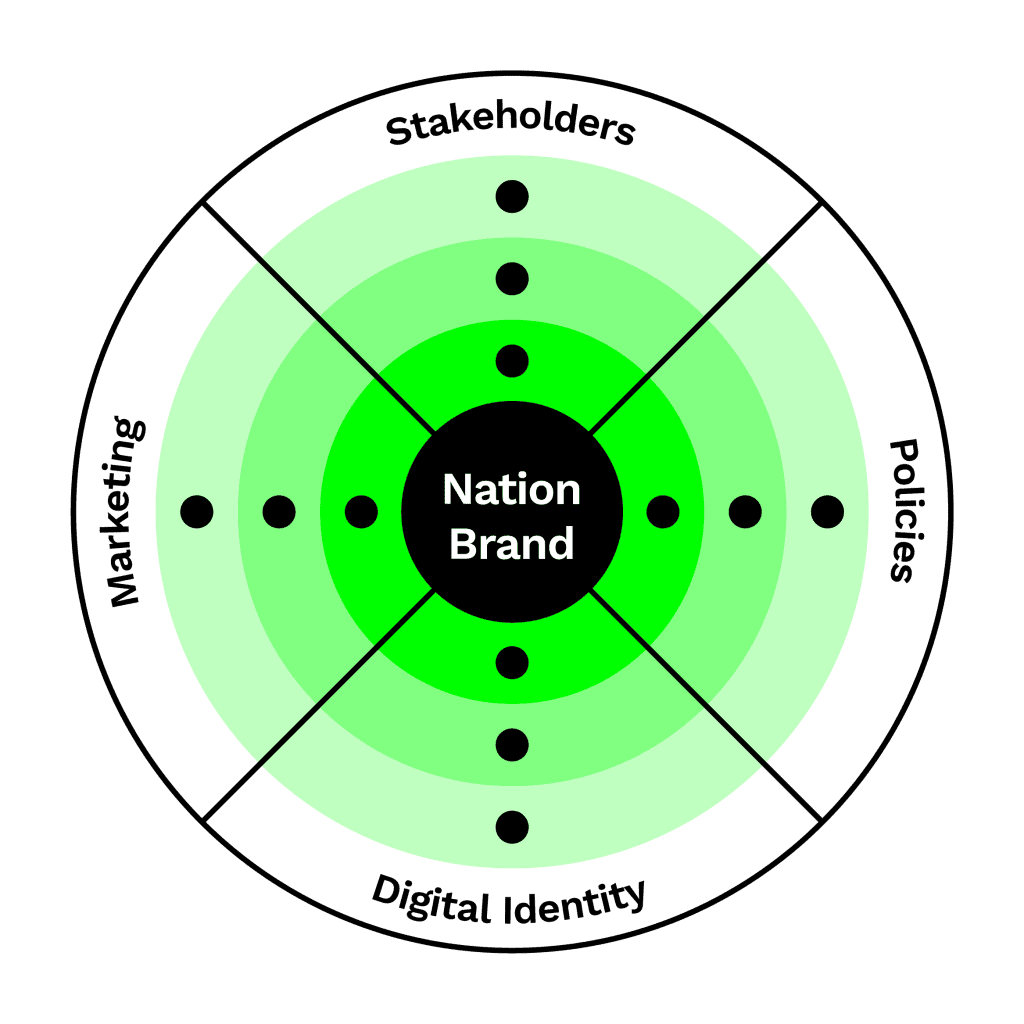
Image: Bloom Consulting Spider Brand Methodology diagram (Brand Touchpoints)
This matters because screen culture is double-edged. A film industry can be a powerful Nation Branding asset and a source of image crisis at the same time, depending on which productions travel furthest and what they say about the place. Intentionally creating and supporting content that reflects a place’s authentic identity helps strengthen a Nation Brand rather than undermine it.
Why film success alone is not enough for Nation Branding
Three risks recure when places treat film exposure as a pure gift rather than a managed Touchpoint.
- The first is stereotyping. Entertainment thrives on shorthand. Romanticised portrayals create visitor expectations the real place cannot meet, and darker portrayals amplify isolated issues into perceived national characteristics.
- The second is the short-term peak. Tourism numbers driven by a single production fall almost as fast as they rise, unless the place backs them with infrastructure, experience design and policy support. Hosting a film, like hosting an event, is not a strategy in itself.
- The third is overtourism and social pressure. When a quiet location becomes a viral set, housing, public services and community life come under strain. Without governance, the reputational win can turn into a local political problem.
How to turn film exposure into long-term Nation Brand value
The strategic question is not whether a place appears on screen, but whether it can leverage what appears. Four checks help a Nation or City Brand manager turn exposure into a brand value:
- Narrative alignment. Does the portrayal reinforce the place’s Central Idea and its current or desired Perception Elements?
- Stakeholder coordination. Are tourism boards, film commissions and municipal/nation authorities ready to capitalise on the surge of interest, together?
- Experience consistency. Will visitors who arrive expecting the screen version of the place recognise what they find when they get there?
- Measurement. Are shifts in perception, demand and visitor behaviour being monitored, so the strategy can be adjusted?
Treated this way, screen productions become powerful amplifiers. They cannot substitute for governance, cultural authenticity or strategic planning, but they can accelerate awareness and emotional connection where those already exist.
Conclusion
So, can movies and television series really boost a country or city image? Yes, but only on terms the place sets for itself. Films expand visibility, attach emotion and shape imagination. They do not build a brand. The Place Brands that gain most from screen exposure are the ones whose Central Idea is already clear before the cameras arrive, and whose strategy is ready to absorb the attention when it does.
In an era where audiences meet places on screen first, the challenge for policymakers and Place Branding professionals is not to chase film productions. It is to ensure that whatever story is told contributes, coherently and consistently, to the longer story the place is telling about itself.
Published on: 18.08.2026
Cite article: Bloom Consulting (2026). Can movies and TV series really boost a country or city image? Bloom Consulting Journal, 18 August. Available at: https://www.bloom-consulting.com/journal/movies-tv-series-boost-country-city-image/