1. Idanha-a-Nova’s journey from rural decline into a European reference
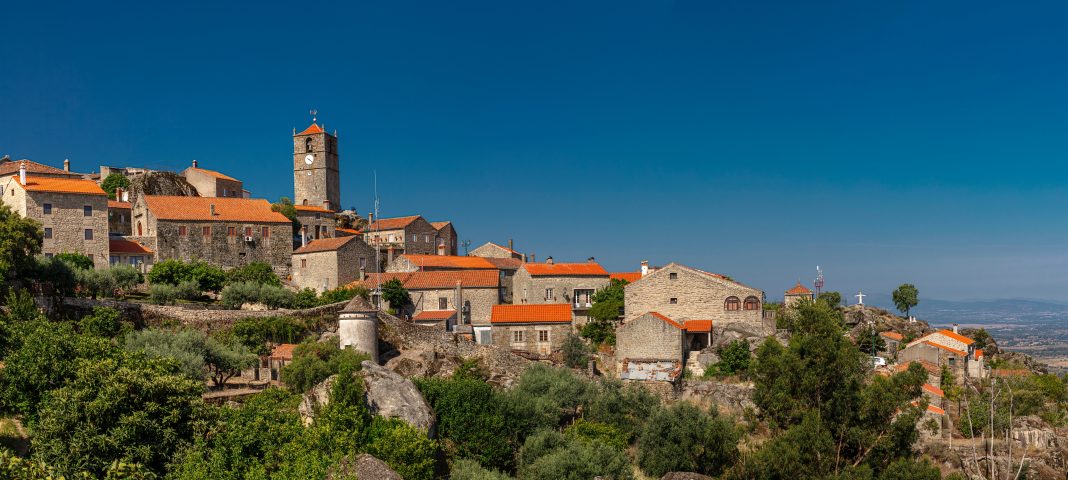
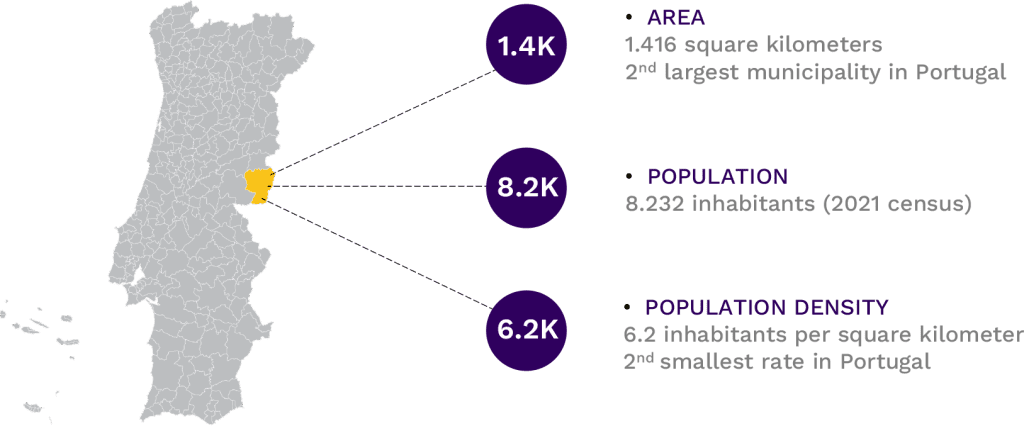
In the heart of Portugal’s interior, in the Spanish border, Idanha-a-Nova represents one of the most striking demographic stories in Europe. Despite covering 1,416 km² (the second-largest municipality in Portugal) it is home to just over 8,000 inhabitants, making it one of the least densely populated territories in the country, with 6.2 inhabitants per km².
The contrast between its vast geography and its shrinking population could not be sharper. Once home to 35,000 residents, Idanha lost 70% of its population over five decades, a dramatic decline that threatened its economic vitality, service capacity, and long-term sustainability.

By 2013, Idanha-a-Nova had become a symbol of the structural challenges facing Portugal, or even Europe’s rural interior:
• decades of outward migration,
• negative demographic momentum,
• the perception of being “left behind,”
• limited visibility beyond regional boundaries.
Yet, it was precisely because of these challenges that Idanha offered something rare: an unmissable opportunity to redefine what rural territories can achieve through strategic Place Branding.
Bloom Consulting’s involvement from 2014
In 2013, the municipality Mayor reached out to Bloom Consulting with a bold question: Can a small, shrinking rural municipality reshape rural perceptions and re-attract people, businesses and opportunity?
In 2014, Bloom Consulting initiated a comprehensive diagnostic process that included:
• a full territorial audit,
• internal and external stakeholder consultations,
• perception studies in major Portuguese cities,
• Digital Demand© analysis,
• fieldwork and benchmarking.
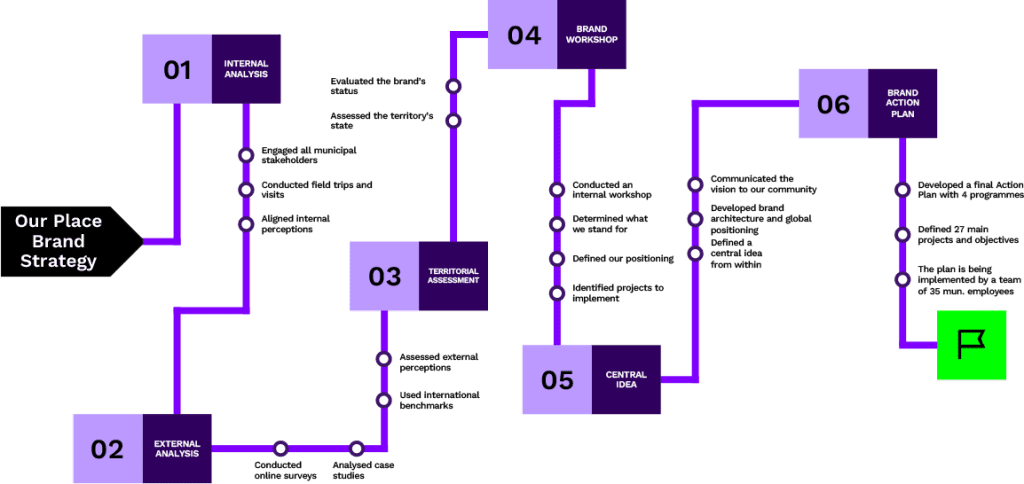
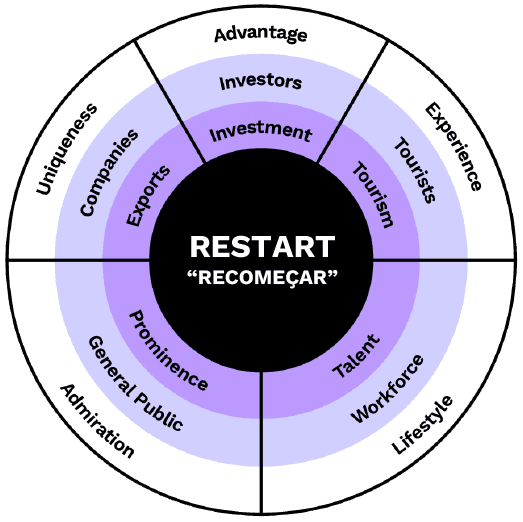
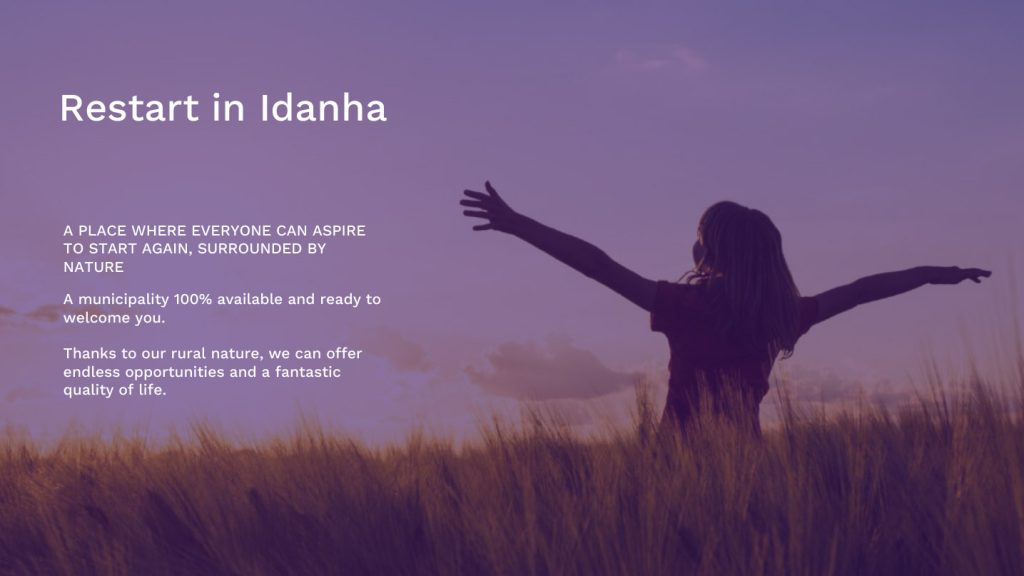
This work led to the development of a long-term Place Brand Strategy, built around a Central Idea: “Recomeçar em Idanha” or Restart in Idanha, a place where anyone can start again, surrounded by nature and opportunity.
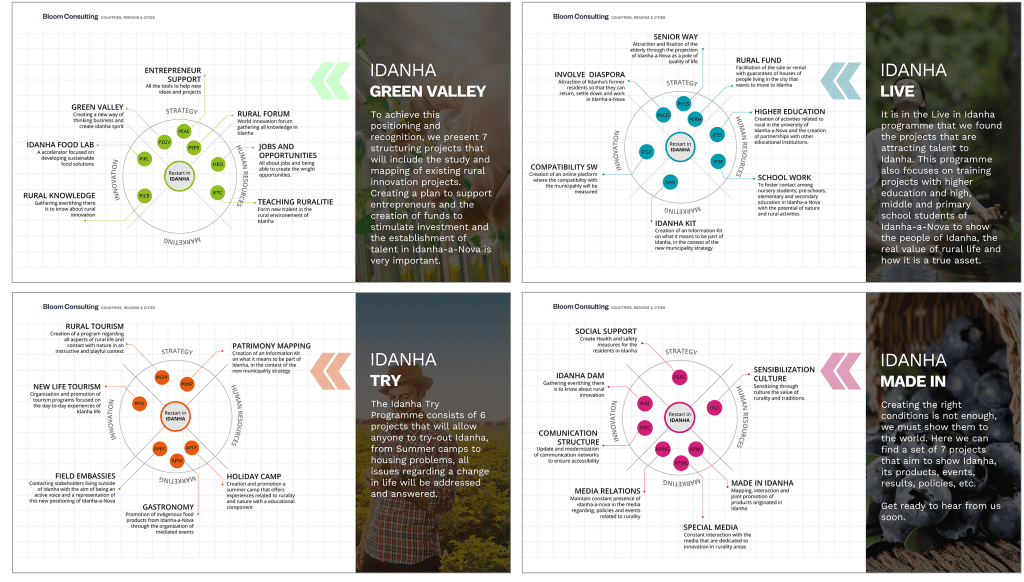
Far from a marketing campaign, this was a structural strategy, translated into four flagship programmes – Idanha Live, Idanha Try, Idanha Green Valley, and Idanha Made In – each designed to address demographic recovery, economic revitalization, and perception change. (Know more details here)
Bloom Consulting’s involvement did not end with the delivery of the strategy. Over the next decade, Bloom remained a close partner, supporting:
• implementation,
• measurement through D2 methodologies,
• adjustments to evolving conditions,
• and impact evaluations, including the major 2014-2025 comparative study on national perceptions and migration intent.
This continuity – from diagnosis, to design, to decade-long support – created the foundation for one of Europe’s most compelling rural Place Branding success stories.
2. The end of the rural myth: why small places CAN compete and win
How Idanha-a-Nova transformed constraint into opportunity
When Idanha-a-Nova began its Place Branding journey, it faced not only demographic decline but also a powerful and persistent myth: that rural territories are inherently disadvantaged, unable to compete with urban centres for talent, investment, or attention. For decades, national narratives reinforced the idea that innovation belonged to cities, while the interior was destined to fade quietly into irrelevance. Idanha-a-Nova refused to accept this narrative from the start.
Reframing rurality: from limitation to value proposition
The core strategic shift happened when the municipality – supported by Bloom Consulting – redefined its own identity. Instead of attempting to imitate cities, Idanha embraced what made it unique:
• space, nature and tranquillity,
• authentic communities,
• a slower, healthier lifestyle,
• a vast and intact territory,
• a cultural and environmental heritage of extraordinary richness,
• and political willingness to innovate.
These were no longer liabilities; they became competitive advantages in a world increasingly seeking sustainability, wellbeing, and balance.
Idanha transformed a seemingly impossible context into a bold, differentiating promise: You can restart your life, your business or your future here – in a place big enough for your ambition, and small enough to care.
This reframing was powerful because it aligned perfectly with emerging global trends: remote work, the search for quality of life, demand for nature, and the rise of purpose-driven migration.
A new narrative for a new rurality
Instead of accepting the fatalism associated with shrinking rural areas, Idanha positioned itself as a rural innovator, a testbed for new ideas, and a territory where change is not only possible but welcomed. The municipality leveraged its scale – being one of Portugal’s largest territories (twice the size of Madrid) – as a symbol of possibility, not emptiness.
Through the Green Valley programme, rurality became synonymous with innovation. Through Idanha Try, it became a low-risk environment for experimentation. Through Idanha Live, it became a clear lifestyle choice. Through Idanha Made In, it became a brand.
Breaking the myth: evidence, not theory
What Idanha proved, definitively and with measurable results, is that small places can not only compete but also win, provided they:
• know who they are,
• invest consistently in their identity, and
• build governance that ensures the brand survives political cycles.
The ten-year results speak for themselves:
• More people know Idanha.
• More people consider living there.
• More businesses choose to operate there.
• Media, investors and international institutions now look to Idanha as a benchmark.
A small rural municipality became a European reference, overturning the idea that only major cities with big budgets can shape their future through Place Branding.
3. A municipality with a vision. 10+ years of political and community commitment
Long-term implementation as the real differentiator. Focus and commitment
Place Branding succeeds not because of a strategy document, and certainly not because of a new logo, or a campaign. It succeeds because of governance, consistency, and time – three elements that are rare in public administration, but essential for transformation.
Idanha-a-Nova is one of the clearest examples of what happens when a municipality commits, unwaveringly, to a long-term vision.
Political will: the spark that ignited the process
When Idanha invited Bloom Consulting in 2013, it was not driven by short-term political incentives but by a deep recognition that the municipality required a structural solution to a structural problem. The administration understood that reversing demographic decline would take not months or years, but a decade or more.
This political maturity set Idanha apart from the beginning. Rather than seeking quick wins, the municipality embraced the uncomfortable but necessary truth: the territory needed a new narrative, new tools, new programmes, and a new mindset.
Few small municipalities maintain coherence across electoral cycles. Idanha did, and that made all the difference.

timeframe from the start. Bloom Consulting © Since 2003.
Governance: the often-invisible engine behind success
One of the most decisive factors behind Idanha’s long-term results was the establishment of a structured implementation framework.
The municipality created a dedicated team of municipal employees responsible for carrying out the strategy’s programmes and long list of projects.
This institutional structure ensured that the Place Brand Strategy was not a “vision” but an operational reality inside the municipality. It survived changes in priorities, budgets, and even external crises like the pandemic. It became part of Idanha’s DNA.
Community engagement: to build a shared vision
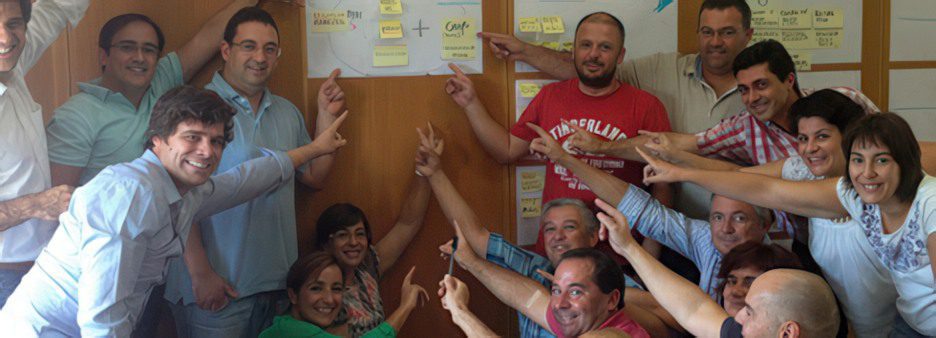
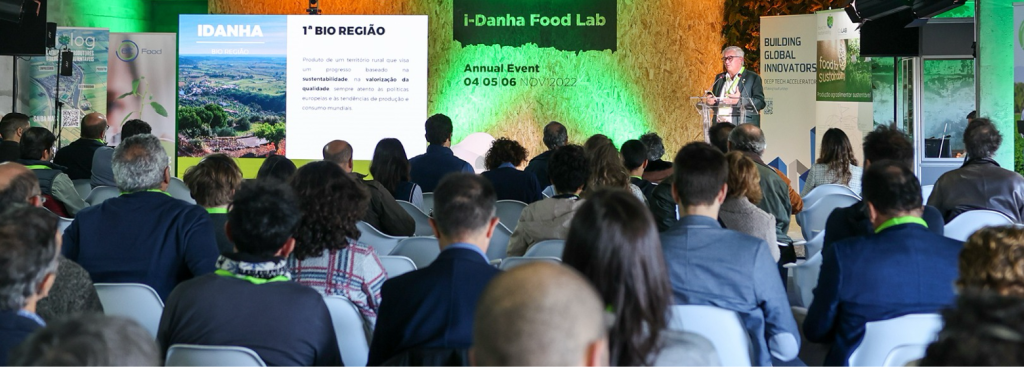
The strategy did not live inside the town hall; it lived in the community. From the earliest stakeholder workshops and field visits to the collaboration with entrepreneurs, schools, health institutions, agricultural producers, and associations, Idanha ensured that Place Branding was not designed for the community, but with the community.
This participatory foundation meant that Idanha’s Place Brand was not imposed. It was co-created, giving residents a sense of pride, ownership, and purpose. As a result, Idanha-a-Nova’s identity became more than a brand. It became a movement.
Consistency over a decade: the rarest ingredient.
The story of Idanha-a-Nova is not one of spectacular overnight change. It is a story of:
• consistent implementation,
• patient investment,
• rigorous measurement, and
• staying the course even when results were not immediate.
In a policy environment often driven by short-term cycles, Idanha made a rare decision: to commit to a 10-year journey from the start and maintain it. That is why the results we see today in perceptions, demand, attraction, and recognition are not accidents. They are the direct outcome of a decade of strategic discipline.
4. The proof is in the data: how Idanha reversed perceptions, demand and demographics
The data sources reveal a decade of transformation
Evaluating the long-term impact of Idanha-a-Nova’s Place Brand Strategy required a rigorous and multidimensional approach. For that reason, Bloom Consulting relied on three complementary data sources: D2 LiveQuanti® perception surveys, D2 Digital Demand® behavioural search data, and municipal performance indicators collected throughout the implementation of the “Recomeçar” strategy. Together, these sources allowed the municipality to not only measure how people think about Idanha, but also how they behave toward it, and how these perceptions ultimately translated into real economic and social outcomes.
A. Perception, familiarity and willingness to move by D2 Live Quanti®
D2 Live Quanti® is Bloom Consulting’s survey-based methodology used to analyse awareness levels, perceptions, associations, and migration willingness among residents of Portugal’s major urban areas. In Idanha’s case, two comparable surveys were conducted: the first in 2014, before the Place Brand Strategy was implemented, and the second in 2025, after a decade of continuous work.
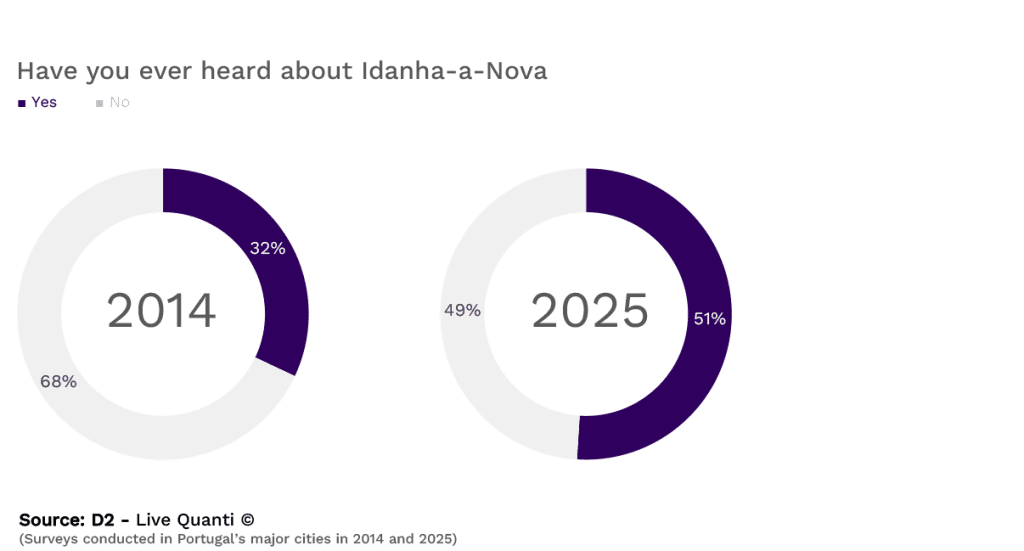
The difference between these two moments tells a powerful story. In 2014, familiarity with Idanha-a-Nova was limited: only about a third of respondents had heard of the municipality (32%). By 2025, that number had climbed to more than half (51%), reflecting a substantial improvement in national visibility.
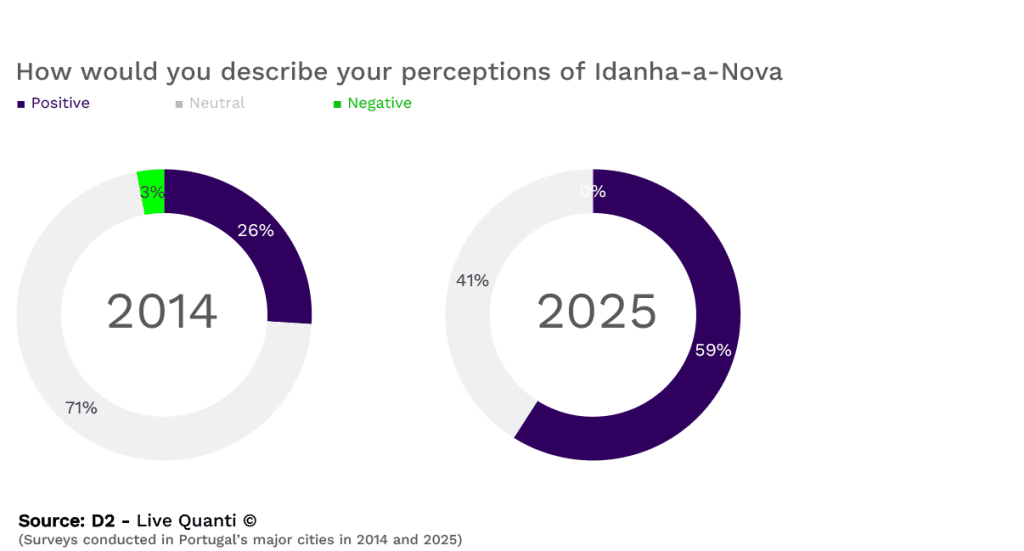
More importantly, perceptions shifted dramatically. Where positive associations once represented barely a quarter of opinions, they now constitute the majority, rising from 26% to 59%, and the small share of negative perceptions recorded in 2014 had completely disappeared by 2025.
Perhaps the most striking figure concerns migration intention: willingness to move to Idanha (after explaining the territory) rose from 22% to 70%. This evolution demonstrates that beyond awareness and reputation, Idanha increasingly appears as a place where people can imagine themselves living.
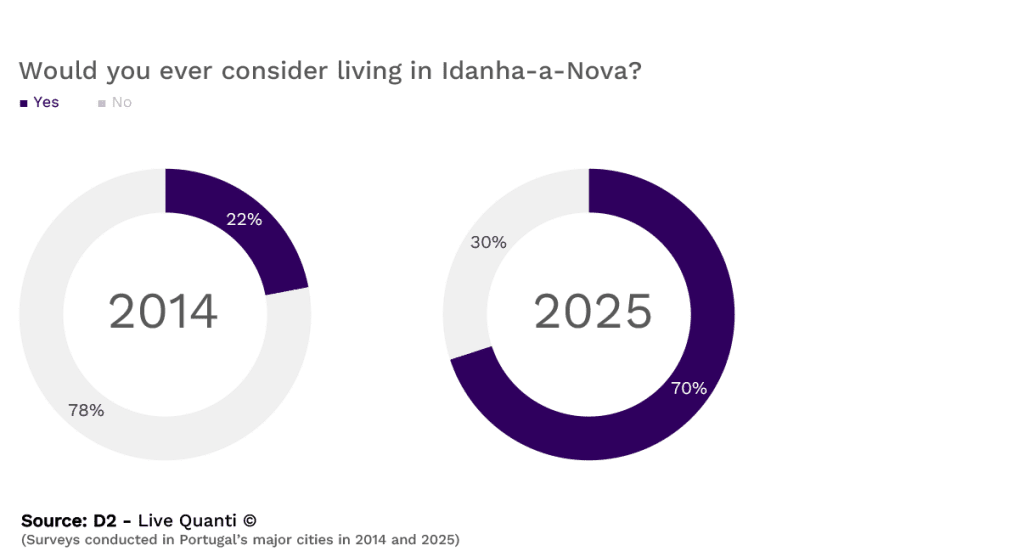
These survey findings confirm that the strategy not only improved how Idanha is seen but also expanded what the territory represents in the national imagination: from a declining rural municipality into a credible lifestyle alternative.
B. Search growth by D2 Digital Demand®
If perception surveys reveal what people say, digital behaviour reveals what they actually do. D2 Digital Demand® is Bloom Consulting’s proprietary tool that measures real-time interest in a place by analysing millions of search engine queries. It captures what individuals look for, which topics attract their curiosity, and how these patterns evolve over time. For Idanha-a-Nova, this provides an objective view of how the territory’s relevance has changed during the 2013-2024 period.
The behavioural data confirms a steady, long-term rise in interest. Online searches relating to Idanha grew nearly sixfold between 2013 and 2024 (588%), mirroring the brand’s consolidation and visibility. Furthermore, the nature of these searches evolved. While rural life initially dominated the interest profile, in recent years demand has diversified into areas such as healthcare, historical heritage, employment opportunities, entrepreneurship and business, and quality of life. This expansion indicates that Idanha is increasingly perceived as a multifaceted territory where people can live, invest, work, and build projects and not merely as a countryside destination.
What is equally notable is the geographic transformation of digital demand. Ten years ago, international interest represented only a small share of searches. Today, nearly a quarter originate outside Portugal, with more than 30 countries showing consistent engagement with the municipality. This internationalisation of interest is rare for a rural territory of Idanha’s size and speaks to the strength of its positioning as a rural innovator.

C. Economic and social outcomes by Municipal performance data
Beyond perceptions and online behaviour, the ultimate measure of a Place Brand’s success is its ability to generate tangible results. Municipal data collected during the implementation of the “Recomeçar” strategy demonstrates a clear link between Idanha’s evolving image and concrete outcomes on the ground. More than one thousand individuals formally contacted the municipality expressing interest in relocating and were personally accompanied by the local “restart” support teams. More than three hundred businesses started or relocated operations in Idanha due to the strategy’s enabling conditions. These entrepreneurial activities either created or are in the process of creating more than three hundred new jobs and together represent an estimated investment potential of €29 million. These numbers are particularly meaningful for a municipality of only 8,000 residents, demonstrating that demographic and economic regeneration is not only possible, but already underway.
One of the most significant and symbolic outcomes of the past decade is the inversion of Idanha-a-Nova’s demographic curve. After more than fifty years of continuous population loss, the municipality has finally reached migratory balance, marking the first time in decades that the number of people arriving equals or exceeds those leaving.
This turning point is not a short-lived fluctuation but the cumulative result of improved perceptions, rising national interest, diversified economic opportunities, and the structured programmes that supported relocation and integration. In a European context where rural depopulation remains dominant, Idanha’s demographic stabilisation – and early signs of renewal – stands as one of the clearest indicators that the territory’s Place Brand Strategy has produced lasting, structural impact.
D. Community and visibility achievements by digital and media analytics
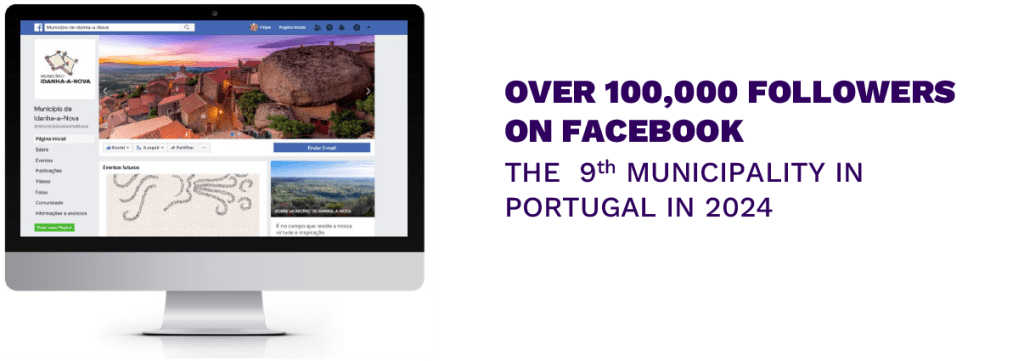
Finally, the evolution of Idanha’s presence in digital and traditional media illustrates the consolidation of its public profile. The municipality’s social media channels experienced exponential growth, especially on Facebook, where the audience expanded from just a few thousand followers in 2014 to nearly one hundred thousand today, a figure that places Idanha among the TOP 10 most followed municipalities in Portugal. This unprecedented level of engagement reflects both local pride and external curiosity.
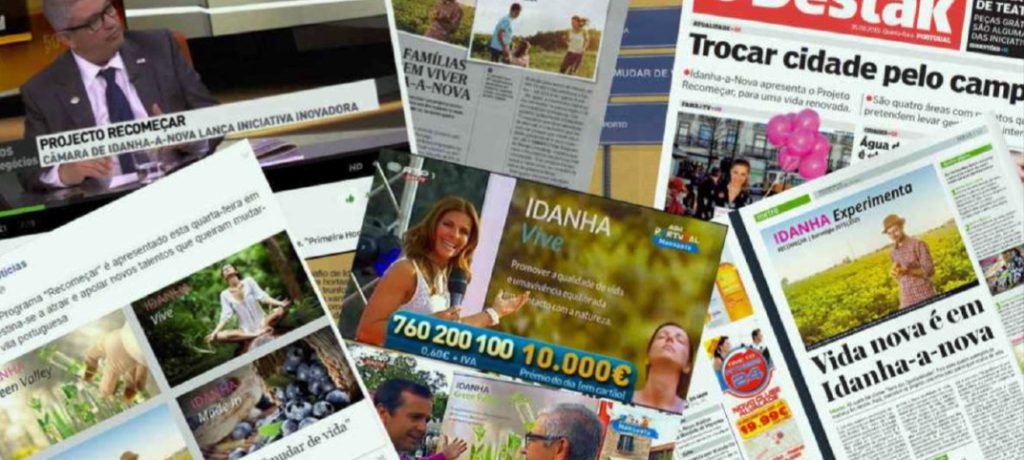
Media visibility followed a similar trend. Over 150 news articles, significant TV coverage, and millions of euros in estimated media value contributed to shifting the narrative around Idanha, from a story of decline to one of innovation and opportunity. These communication indicators reinforced the momentum created by the brand strategy and amplified its reach across national and international audiences.
A Data-driven transformation
When taken together, these three data sources – perception surveys, digital behaviour analysis, and municipal outcome indicators – paint a consistent and compelling picture. Over the past decade, Idanha-a-Nova has become better known, better perceived, more searched, more attractive to potential residents, and more successful in generating economic and social activity. The strategy not only changed perceptions; it changed behaviours. And it not only changed behaviours, but it also changed the municipality itself.
5. A small municipality on Europe’s stage
Ten years after Idanha-a-Nova launched its Place Brand Strategy, the municipality’s efforts have not only transformed local realities but also captured international attention. What began as an ambitious attempt to reverse demographic decline in a rural corner of Portugal has evolved into a case study referenced by experts in Europe and beyond. Two recognitions illustrate the growing resonance of Idanha’s journey: the Highly Commended distinction at City Nation Place (CNP) and the designation of Idanha’s strategy as a Good Practice by the URBACT programme.
Both recognitions matter, but for different reasons. Together, they demonstrate that Idanha’s results are not only local, but they are also globally relevant.
City Nation Place, a global stage for Place Branding excellence
City Nation Place is one of the world’s leading platforms for recognising excellence in Place Branding, attracting submissions from capitals, regions, and major cities across the globe. Being Highly Commended for Place Brand of the Year placed Idanha-a-Nova among the top-performing Place Brands internationally, a remarkable feat for a rural municipality of just 8,000 inhabitants and a small budget. (Know more here)
This distinction from CNP validated the integrity of the strategy. It recognised how Idanha aligned identity, governance, long-term vision and data in a way that many larger, more resourced territories struggle to achieve. For the Place Branding community, Idanha’s recognition was a reminder that powerful brands do not depend on size, visibility, or budget; they depend on authenticity and strategic discipline.
CNP placed Idanha on the global map. URBACT, however, did something even more impactful: it positioned Idanha as a model for other cities.

What URBACT is; and why it matters so much for Idanha
URBACT is the European Union’s flagship programme for developing, evaluating and disseminating innovative, sustainable, and participatory urban strategies. It identifies local initiatives across Europe that demonstrate real impact and proven transferability, promoting them as Good Practices to inspire other municipalities.
Being selected as a Good Practice means that Idanha’s strategy is not only effective, but replicable. URBACT applies strict criteria before offering this distinction. Selected strategies must show measurable transformation, strong governance, community engagement, and the potential to serve as a model for other European cities. Idanha met every requirement. (Know more here).
For Idanha-a-Nova, this recognition is uniquely meaningful because it confirms that the municipality (despite its scale) is not just transforming itself; it is contributing to the future of Europe’s rural policy landscape.

And scale is the key point
The smallest municipality in a European catalogue of good practices.
Looking at previous URBACT Good Practices, the majority come from medium or large cities: places with diversified economies, and large administrative teams. Against this backdrop, Idanha-a-Nova stands out dramatically. With only 8,000 residents, it is almost certainly the smallest municipality ever selected as an URBACT Good Practice, a distinction that underscores the exceptional nature of its strategy.
This matters because it sends a powerful message to Europe: small municipalities are not objects of policy, they can be authors of it.
Idanha’s selection breaks stereotypes about capacity, scale and relevance. It demonstrates that innovation does not belong exclusively to large urban centres. It shows that rural territories, too, can design and implement strategies capable of shifting perceptions, attracting people and investment, and changing their trajectory.
URBACT’s recognition elevates Idanha-a-Nova from a local success to a European reference. Throughout 2024-2025, the municipality’s work will be promoted across URBACT’s communication channels, shared in international forums, and studied by cities seeking new tools to address depopulation, rural decline and perception challenges. The invitation to present at the URBACT City Festival 2025 in Wroclaw is not only an honour; it is an opportunity for Idanha to inspire and guide other territories across the continent.
A rural municipality as a European teacher
For a place once seen as too small, too remote, too old, or too sparsely populated, Idanha-a-Nova has reversed the logic entirely. Today, it stands as a teacher for Europe, offering a real-world demonstration that with vision, governance, and persistence, even the smallest municipality can redefine its destiny and influence others.
In the landscape of European Place Branding, Idanha now occupies an extraordinary position. CNP showed that it belongs among the best in the world. URBACT showed that it can help others get there.
6. Lessons from Idanha: a playbook for rural transformation
Idanha’s transformation is often described as remarkable, but its success was not accidental. Nor was it the result of a single project, personality, or campaign. It emerged from a combination of identity, governance, persistence and methodology; a combination that can be replicated elsewhere. If Idanha stands today as one of Europe’s most inspiring rural success stories, it is because of the consistent application of a few essential principles.
The first factor behind the strategy’s success was the decision to start from identity rather than invention. Idanha did not attempt to become something it was not. Instead, it embraced the essence of the territory, its rurality, its tranquillity, its vastness, and its intimate relationship with nature. The brand “Recomeçar em Idanha” emerged not from external projection but from internal recognition: a shared understanding that Idanha could be a place for new beginnings. This authentic foundation gave the brand credibility, coherence and emotional resonance. It became a compass that guided every decision, project and communication throughout the decade.
The second factor was governance. Many municipalities articulate compelling visions, but few manage to create the administrative structure required to implement them consistently. Idanha did. The municipality institutionalised the Place Brand Strategy by assembling a dedicated team, integrating the brand into policy decisions, and ensuring continuity across electoral cycles. This long-term commitment turned strategy into reality, year after year. Without governance, Place Branding is a slogan; with governance, it becomes a transformation.
Another crucial element was measurement. From the beginning, Idanha understood that a brand cannot be managed without data. By using D2 LiveQuanti® perception surveys, D2 Digital Demand® behavioural analysis, and ongoing municipal performance indicators, the municipality could monitor its evolution, validate decisions and adjust its approach over time. Measurement prevented stagnation. It created accountability. It proved impact. And it demonstrated to residents, investors and institutions that the strategy was both serious and effective.
Idanha also succeeded because it embraced participation. The brand was not imposed from above; it was co-created through workshops, consultations, field visits and collaborations with citizens, entrepreneurs, educators and cultural leaders. This participatory process not only enriched the strategy but also created a sense of shared ownership. People defend what they help build. Over time, the brand became not just a municipal narrative but a community movement.
Finally, Idanha thrived because it accepted the most overlooked truth in Place Branding: real change requires time. The municipality resisted the temptation of short-termism. It allowed the brand to mature, programmes to take root, and perceptions to evolve gradually. In doing so, Idanha demonstrated something rare: patience. And patience, combined with consistency, turned into impact.
These lessons form the essence of Idanha’s playbook for other small and rural territories. Start from who you are. Build governance that outlives political cycles. Measure everything. Engage your community. And above all, commit for the long term.
The story of Idanha-a-Nova proves that transformation does not belong exclusively to large cities or powerful regions. With the right strategy and steadfast dedication, even the smallest municipality can redefine its future and inspire others to do the same.
7. Conclusions and looking ahead: Idanha-a-Nova and the future of rural Place Branding
The results speak clearly. Idanha is no longer a symbol of rural abandonment; it has become a reference point, both nationally and internationally, for rural innovation, quality of life, entrepreneurship, and cultural vitality. It has changed how citizens see it, how the country speaks about it, how people search for it, and how businesses and families choose to engage with it. The municipality has achieved what many would have believed impossible: it has reversed decline not through imitation of cities, but through deep understanding and affirmation of its own essence.
Yet perhaps the greatest achievement of the past decade is not found in the data, but in the shift of mindset that Idanha inspired. The belief that small, rural territories cannot compete, cannot innovate, or cannot attract new populations has been thoroughly dismantled. Idanha has proven that a strong identity, articulated with clarity and supported with governance, can be more powerful than size, scale, or geography. It is not the number of inhabitants that determines a place’s potential, it is the vision and persistence of its people.
Looking ahead, Idanha-a-Nova enters a new phase, one marked not by the urgency of reconstruction but by the opportunity of consolidation and leadership. The municipality’s recognition by City Nation Place and its designation as an URBACT Good Practice open new doors for international collaboration, knowledge exchange, and strategic partnerships. These acknowledgments place Idanha in a position to influence how rural policy, demographic regeneration, and territorial innovation are understood across Europe.
The next decade will bring new challenges; climate adaptation, the evolution of remote work, generational transitions, and the continued need to attract and retain residents. But Idanha is no longer responding from a place of vulnerability. It is acting from a position of strength, with a proven strategy, a committed community, and a renewed identity that continues to resonate nationally and abroad. The foundation is solid; the tools are in place; the brand is alive.
The story of Idanha-a-Nova is, ultimately, a story of belief: belief that rural territories matter; belief that identity can drive economic development; belief that small places can lead by example.
Idanha-a-Nova did not simply restart. It redefined what is possible
For a detailed description of the original strategy design and early results, see the first Idanha-a-Nova case study in the Bloom Consulting Journal: “How Place Branding Brought Talent and Business to Idanha-a-Nova“. You can also explore the municipality’s own “Recomeçar em Idanha” platform at idanha.pt/recomecar/
Cite article: Bloom Consulting (2025): Idanha-a-Nova: a 10-year Place Branding Strategy that worked. Bloom Consulting Journal, 18 December. Available at: https://www.bloom-consulting.com/journal/https://www.bloom-consulting.com/journal/idanha-a-nova-place-branding-strategy