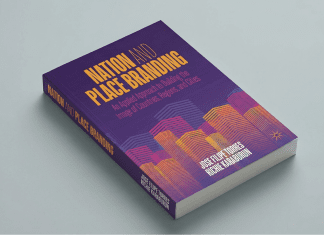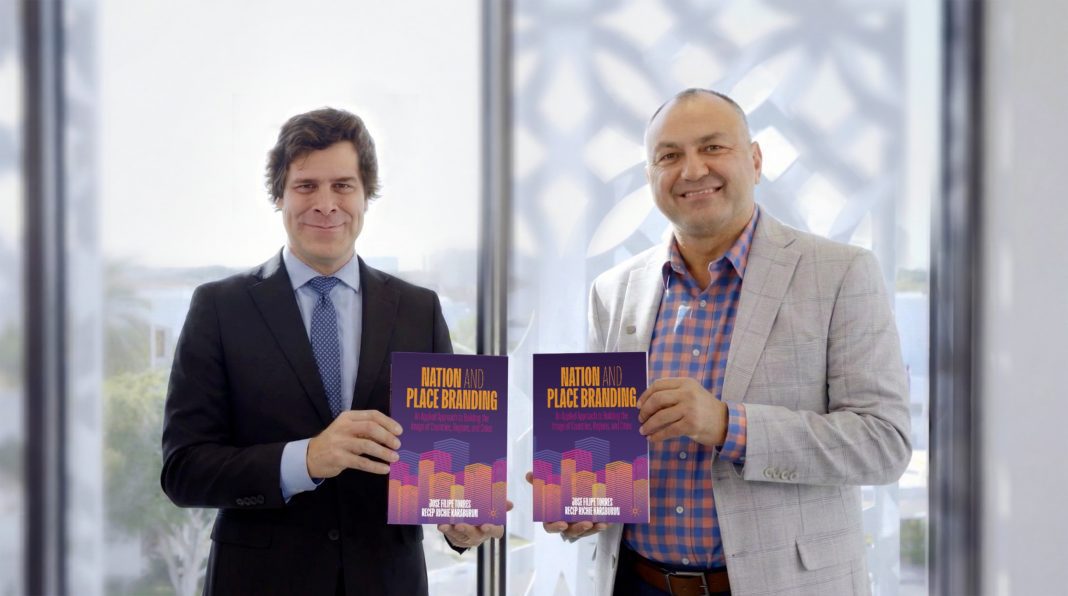
As global competition between countries, cities, and regions intensifies, the strategic importance of Nation and Place Branding has never been greater. In their new book Nation and Place Branding, Jose Filipe Torres, CEO of Bloom Consulting , and Richie Karaburun, Clinical Associate Professor at New York University (NYU), merge academic insight with practical expertise to present a pioneering perspective on how Places can shape perceptions, attract investments, tourists and talent, and build trust in the eyes of the world.
We sat down with the co-authors to discuss the inspiration behind their collaboration, what makes their book stand out, and how they envision the future of the field.
What inspired you to write this book together, and why now?
Jose:
We first met when I was invited to deliver a guest lecture at NYU. Richie and I instantly connected, not only professionally but personally. I presented Bloom Consulting’s 14 steps to Nation Branding methodology and now it has become a part of NYU’s syllabus. Richie saw the value in making it a foundational part of a new book. I immediately said yes. I liked his approach with students and saw a great opportunity to bring our strengths together to create something meaningful.
Richie:
The inspiration came after years of teaching a master-level class on Place Branding and Placemaking at NYU. I had been using another academic book in my course, but the author declined to speak to my students unless paid, which made me think – I can write something better, something more accessible. With over two decades in the hospitality and destination marketing industry, I saw a gap between academic theory and real-world practice. That’s where Jose came in. I admired Bloom Consulting’s work and reached out to him after seeing him in a City Nation Place webinar. We connected via LinkedIn, became friends, and decided to co-author this book. Our partnership merges my academic perspective with Jose’s field expertise, and this book is the applied, practical result of that collaboration.
What was the writing process like? Were there any particularly challenging or rewarding chapters?
Jose:
The biggest challenge was structuring the things we already knew from practice but didn’t always have the time to explain. We wanted every chapter to draw from Bloom Consulting’s real cases to ensure the book wasn’t theoretical but grounded in first-hand experience. For me, the most complex part was clarifying the differences and overlaps between marketing and branding, a nuance that’s often misunderstood. We were also very proud to include a final chapter that summarizes how to actually implement what we teach.
Richie:
The governance and measurement sections were the most challenging but also the most critical. Branding is still a young discipline, especially in the context of Nations and Places, so there’s limited theory. Working with Jose helped tremendously. He brought in real cases like our joint work in Oman, which gave depth to those chapters. We complemented each other’s strengths throughout the process, which made it not only productive but enjoyable.
What distinguishes this book from others in the field of Nation and Place Branding?
Jose:
It might be the first book co-authored by an academic and a practitioner in this field. That duality gives it both credibility and usability. It’s not just a book to understand the theory; it’s a textbook meant to teach how to do Nation and Place Branding. It includes blueprints, exercises, and methodologies, all grounded in real-world experiences. It’s structured to be used not only in classrooms but also by governments, cities, and marketing professionals who need actionable guidance.
Richie:
It bridges the gap between theory and practice. Most books are too academic or overly simplistic. Our book is for students, yes, but also for practitioners, policymakers, and even destination marketing professionals. We integrated Bloom Consulting’s 14-step framework and several case studies, including my own field experiences, to offer readers something they can immediately apply. Students at NYU have already responded positively, especially to Bloom’s framework, which has now become a central teaching tool in my class.
What are the biggest misconceptions about Place Branding that you aim to break down?
Jose:
A huge misconception is that Nation and City Branding is only for big countries and cities or those with large budgets. It’s not. It’s for everyone. Another is the belief that you can’t manage or influence a Place’s perception. You can, with the right approach. This book aims to show how. Most importantly, it argues that Place Branding should be a recognized profession, just like managing infrastructure or healthcare. Cities and countries should have teams responsible for managing their image. Branding is about perception, not promotion.
Richie:
The idea that branding is just about designing a new logo. That’s the biggest misconception. Many destinations think changing visuals alone will transform perception. But branding without stakeholder engagement, political alignment, or a real narrative is cosmetic. Place Branding is a nation building. It requires structure, community involvement, and consistency across policies and touchpoints.
How is Artificial Intelligence influencing the field of Place Branding?
Jose:
AI opens up a new era of Nation and Place Branding 2.0. On one hand, it’s an incredible opportunity for countries and cities to use digital tools to manage their image more effectively. On the other hand, the risk of misinformation and fake content are real. This makes it even more crucial to actively manage Digital Identity. We cover this extensively in one of the chapters and show how digital touchpoints, now driven by AI, can shape global perceptions.
Richie:
AI is transforming everything. From personalization of destination offerings to how data is analyzed and applied. I teach a course on trends in travel and tourism where we look at AI’s role in enhancing Destination Branding strategies. AI enables us to hyper-personalize and respond in real time, but it also challenges us to maintain authenticity. The key will be to use it wisely, ensuring brand consistency while staying agile.
It’s just like fire or electricity: once invented, electricity changed the world, making it more efficient and more productive. Artificial Intelligence is following a similar trajectory, becoming a transformative force that will continue to reshape how Place Branding is conceived, managed and experienced.
Do you see growing interest among students and professionals in pursuing careers in Place Branding?
Jose:
That’s one of the goals of the book. To professionalize this sector. We want readers to see that Place Branding is not only a real career path, but a critical role in nation and city governance. What we see globally is an evolution in quality: professionals are becoming more informed, more strategic, and more driven to apply deep insights, not just promotional tactics.
Richie:
Absolutely. I call my students “converters”. They often come in unaware that this field even exists as a career path. But through our classes and guest lectures (including Jose’s appearances), they see the impact and relevance. Many get inspired to pursue roles in public policy, tourism, or investment promotion. And with the increasing relevance of data and AI, the sector is becoming even more dynamic and attractive.
What is the main message or takeaway you hope readers will walk away with after reading the book?
Jose:
That Nation and Place Branding is a profession. It impacts economic development well beyond tourism and should be treated as a core responsibility within city and country governance. The book provides a clear roadmap – this is how you do it. It’s not about wishful thinking; its about structured, ongoing effort.
Richie:
That Nation Branding is not just an exercise in visual identity. It’s a strategic, structural process that touches on policy, perception, and purpose. If you want to build a better reputation, start with better practices. A Nation Brand should reflect reality and aspirations – it’s about trust, not slogans.
Final thoughts or messages you’d like to share with readers of the Bloom Consulting Journal?
Jose:
This book is packed with tools, case studies, and frameworks you won’t find elsewhere. We even brought in guest contributors, including voices from the World Economic Forum and leading academics. If you are reading this, know that you have access to a resource that NYU itself uses to teach the next generation of Place Branding professionals. It’s comprehensive, practical, and designed to be used.
Richie:
I’m truly excited about what we’ve created. This is not just a book. It’s a bridge between academic learning and real-world application. My hope is that it becomes a go-to resource for governments, universities, marketing agencies, and tourism professionals alike.
Cite article: Bloom Consulting (2026): Nation and Place Branding: an interview with the authors of the new book, 11 February. Available at: https://www.bloom-consulting.com/journal/nation-and-place-branding-book-interview/
Published on 11.02.2026.